Victorian Curriculum F–10 Version 2.0
On this page:
- Overview
- Foundation Levels A to D curriculum provision
- Timeline for curriculum revision and implementation
- Curriculum planning support for schools
- Reporting
- Stay up to date
- Contact
Overview
Victorian schools have now started teaching and assessing the Victorian Curriculum F–10 Version 2.0. This revised curriculum gives students the best opportunity to thrive in a world of increasing change and rapid technological advancement. It reflects the expertise and feedback of Victorian teachers, making it easier for them to plan, assess and report on student learning.
In 2026, teachers of the following should continue to use the curriculum materials published on the Victorian Curriculum F–10 Version 1.0 website. See the timeline below for more information.
- English as an Additional Language
- Levels A to D (Towards Foundation) for all curriculum areas except Mathematics
- Phase 3 Languages – Arabic, Classical Greek, Framework for Classical Languages, Hindi, Latin, Non-Roman Alphabet Languages, Roman Alphabet Languages, Turkish, Vietnamese
- Phase 4 Languages – Auslan (First Language Learner and Second Language Learner pathways), Chinese (Background Language Learner and First Language Learner pathways), Victorian Aboriginal Languages
Go to the Victorian Curriculum F–10 Version 1.0
Foundation Levels A to D curriculum provision
The curriculum provision for Foundation Levels A to D in the Victorian Curriculum F–10 Version 2.0 has been refined, based on contemporary research and evidence. Foundation Levels A to D are provided for the Arts, English, Health and Physical Education, Mathematics, Critical and Creative Thinking and Personal and Social Capability. These curriculum areas focus on the fundamental knowledge and skills required by students with intellectual and cognitive disability and learning delay.
Foundation Levels A to D describe a developmentally sequenced continuum of learning in each of these 6 curriculum areas. Each curriculum has been reviewed using developmental trajectories and subject matter expertise to identify the key knowledge and skills leading into the Foundation level. Teachers can use Foundation Levels A to D to support learners with intellectual or cognitive disability or learning delay in any school.
From 2027, Levels A to D (Towards Foundation) for curriculum areas other than these 6 curriculum areas will be retired and should no longer be implemented.
Go to the Victorian Curriculum F–10 Version 2.0 website.
Timeline for curriculum revision and implementation
The VCAA allows time for teachers and school leaders to familiarise themselves with the curriculum, after the revised curriculum has been released and before it needs to be implemented.
The Department of Education and the Victorian Catholic Education Authority determine when schools in their sectors are required to implement revised curriculum areas. Independent schools are responsible for their own implementation timelines.
Timeline (as of Term 2 2026)
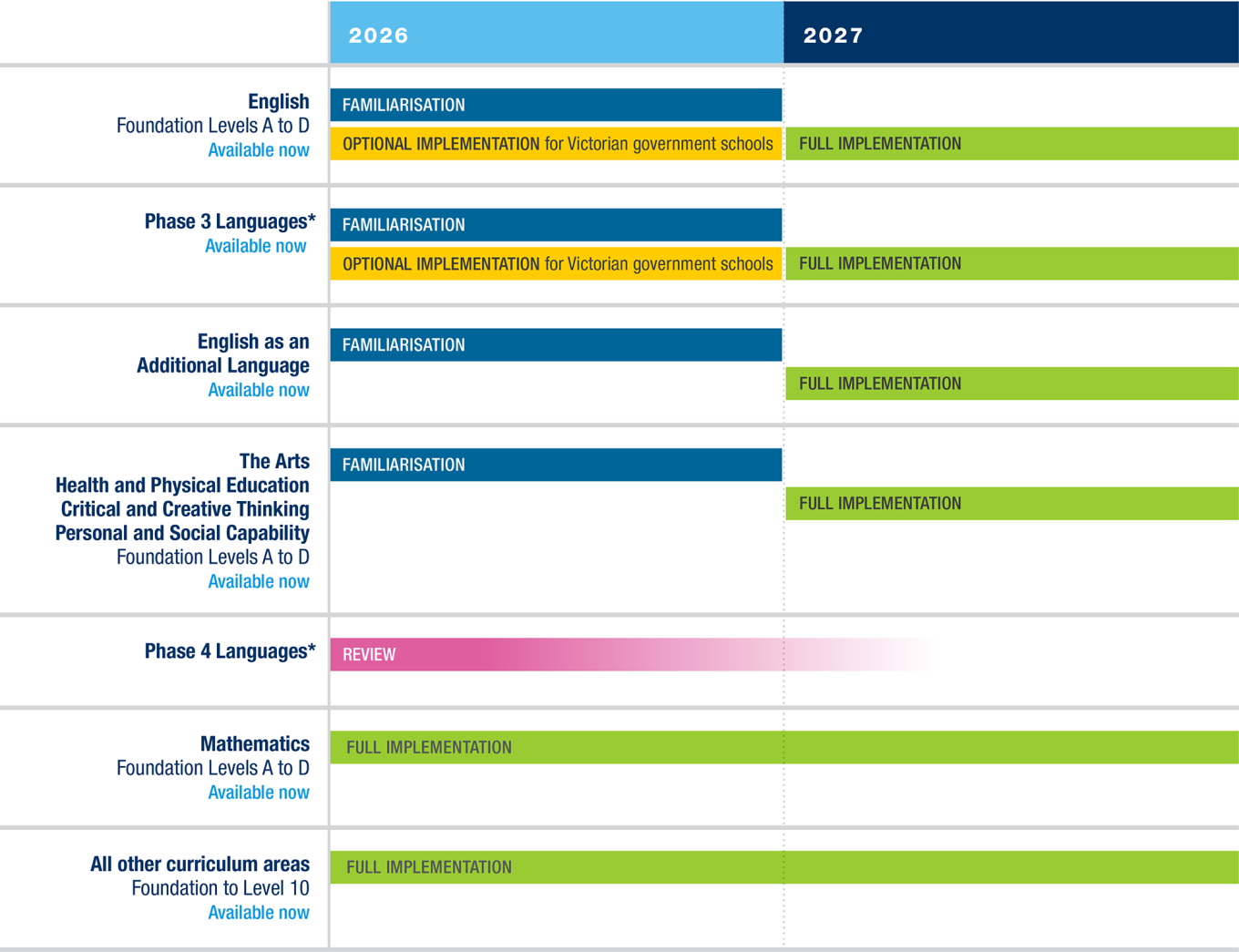
*The revised Languages curriculums have been published in phases.
Phase 1 and 2 Languages are Chinese (Second Language Learner), French, German, Indonesian, Italian, Japanese, Korean and Spanish. They are available now and are to be fully implemented from 2026.
Phase 3 Languages are Arabic, Classical Greek, Framework for Classical Languages, Hindi, Latin, Non-Roman Alphabet Languages, Roman Alphabet Languages, Turkish and Vietnamese.
Phase 4 Languages are Auslan (First Language Learner and Second Language Learner pathways), Chinese (Background Language Learner and First Language Learner pathways) and Victorian Aboriginal Languages.
Curriculum planning support for schools
The VCAA recognises the expertise of practising teachers. We consulted with teachers when developing the revised curriculum, and we are also working with educators to produce curriculum planning resources for schools.
Our new Resource Hub contains high-quality, curriculum-aligned resources to help you plan and implement the Victorian Curriculum F–10 Version 2.0. Curriculum mapping and planning resources are being added across 2026.
Go to the Resource Hub on the Victorian Curriculum F–10 Version 2.0 website
Reporting
All Victorian government and Catholic schools are required to provide written reports on student achievement against the Victorian Curriculum F–10 achievement standards. These written reports are required for every student at least twice per year.
For specific information on reporting, contact your school sector.
- If you work in a Victorian government school, refer to the Department of Education’s advice at Reporting student achievement and progress Foundation to 10.
- If you work in a Catholic school, refer to the Victorian Catholic Education Authority or the Catholic Education Victoria Network (CEVN) portal.
Stay up to date
Contact
Victorian Curriculum and Assessment Authority
email: vcaa@education.vic.gov.au